Breeding
Cattle breeding, lineage and inbreeding risk: a practical guide
Learn how to read a cattle pedigree, spot shared ancestors, calculate inbreeding risk, and make better mating decisions with complete breeding records.
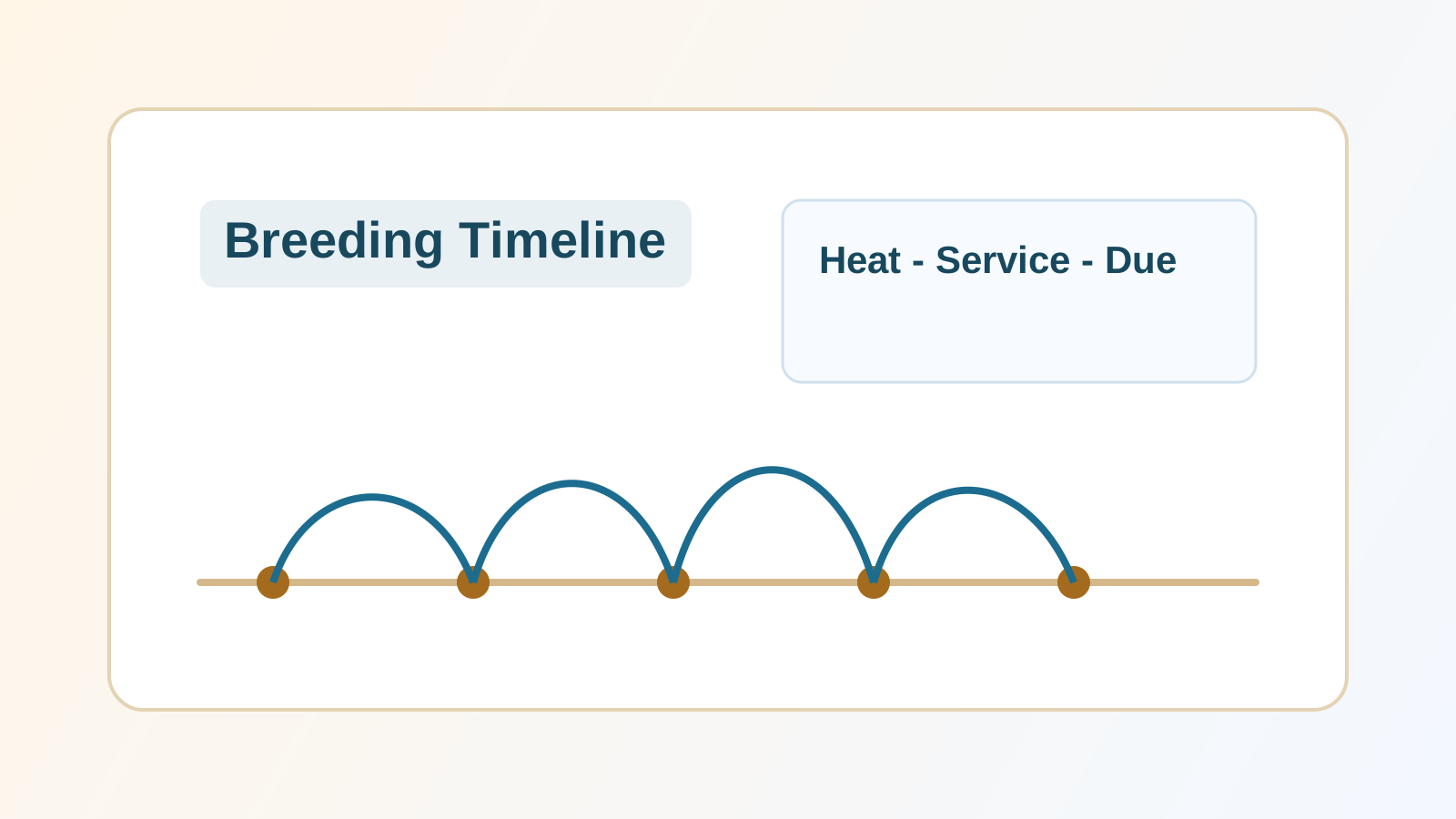
Good cattle breeding decisions start long before a service date. They start with knowing exactly which animals are related, what traits run through their lines, and where a planned mating could concentrate the same genes too closely. That is the practical value of a usable lineage record: it turns a name on a tag into a decision you can explain.
Whether you run dairy cows, suckler cattle, pedigree stock, or a mixed livestock farm, the goal is not to avoid every shared name in a pedigree. It is to understand the relationship, weigh it against your breeding objective, and avoid accidental close matings. This guide explains how to do that, with cattle as the main example.
What lineage means in a cattle herd
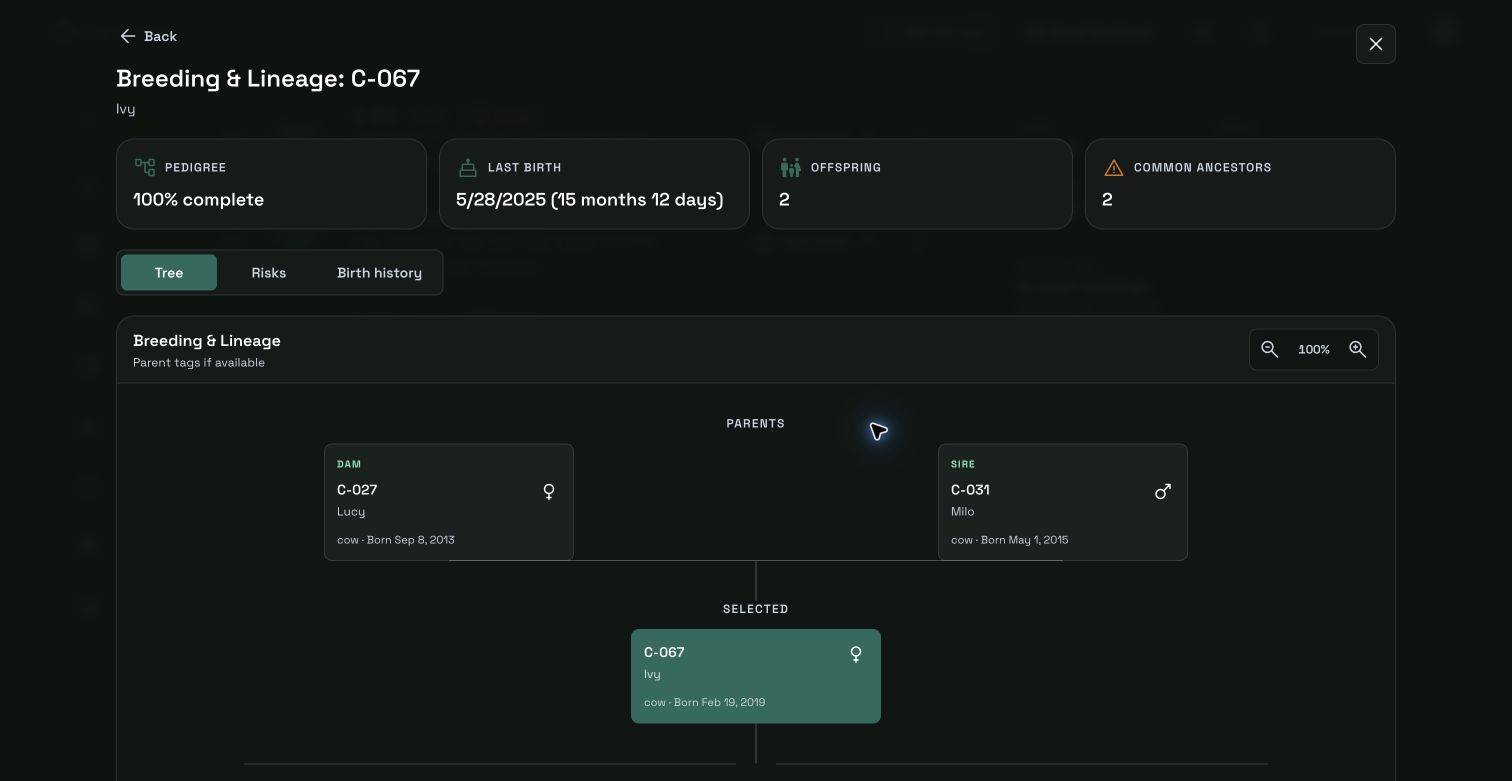
Lineage is the documented chain of an animal’s parents, grandparents, and earlier ancestors. A basic pedigree begins with the animal, its dam and sire. As more generations are recorded, you can see siblings, offspring, repeated ancestors, and the routes by which genes are shared. For a commercial herd, this is useful for avoiding mistakes. For a breeding herd, it also supports selection for fertility, calving ease, milk, growth, conformation, temperament, disease resilience, or the traits that matter on your farm.
- Dam: the animal’s mother.
- Sire: the animal’s father.
- Full siblings: animals with the same dam and sire.
- Half siblings: animals sharing one parent.
- Common ancestor: an animal appearing in both sides of a proposed mating’s pedigree.
- Pedigree completeness: how much of the expected ancestry is actually recorded.
Why complete parent records matter
A pedigree can only reveal the relationships it contains. If a sire is missing, incorrectly recorded, or duplicated under a different name, a risk check may look reassuring when it should not. Aim to record the animal ID, sex, date of birth, dam, sire, breed, and any relevant breeding notes when an animal is added. Use a consistent ID system and correct parentage as soon as you find an error.
When you buy in cattle, retain the breeder’s pedigree information where possible. When you use AI, record the exact sire—not simply the straw brand or a free-text nickname. If DNA parentage verification is part of your programme, keep the verified result with the animal record. Those small habits make later selection and risk reviews much more reliable.
What inbreeding is—and what it is not
Inbreeding occurs when the sire and dam of a calf are related. The calf can receive the same allele from both sides through a shared ancestor, increasing homozygosity. That can make desired, consistently inherited characteristics more predictable, but it can also make unwanted recessive conditions and inbreeding depression more likely to show. Inbreeding is therefore a risk-management question, not a label of good or bad breeding by itself.
The practical concern is often inbreeding depression: lower average performance in traits such as fertility, survival, vigour, growth, disease resistance, and sometimes production. The effects depend on breed, population, the specific traits, how close the relationship is, and the rest of the management system. A breeding record helps you flag a relationship early; it does not replace veterinary, breed-society, or genetic-advisor guidance for a high-stakes pairing.
How an inbreeding coefficient is calculated
The inbreeding coefficient (often written as F) estimates the probability that two alleles at a locus in an offspring are identical by descent. In plain language, it describes how much the pedigree makes the offspring more likely to receive the same genetic copy from both parents because those parents share ancestry.
For each shared ancestor, a standard pedigree calculation uses the relationship path from the proposed dam back to that ancestor and from the proposed sire back to the same ancestor. One contribution is calculated as (1/2)^(n1 + n2 + 1) × (1 + FA), where n1 and n2 are the generations from each parent to the shared ancestor and FA is that ancestor’s own inbreeding coefficient. Add the valid contributions from the shared ancestors to estimate the offspring’s F. Software is valuable here because real pedigrees can have multiple, overlapping paths that are easy to miss by hand.
- Parent-to-offspring or full-sibling matings have an expected offspring F of about 25% when the founders are unrelated.
- Half-sibling matings have an expected F of about 12.5% under the same assumption.
- First-cousin matings have an expected F of about 6.25% under the same assumption.
- Repeated ancestors and already-inbred ancestors can raise the result beyond a simple single-path estimate.
Use a mate-risk check before service
A quick pre-breeding check should compare a prospective sire and dam, list the ancestors they share, and show how close those paths are. That turns a hidden relationship into a prompt for review. If the pedigree is incomplete, treat a low-risk result as limited by the available data rather than proof that the pair is unrelated.
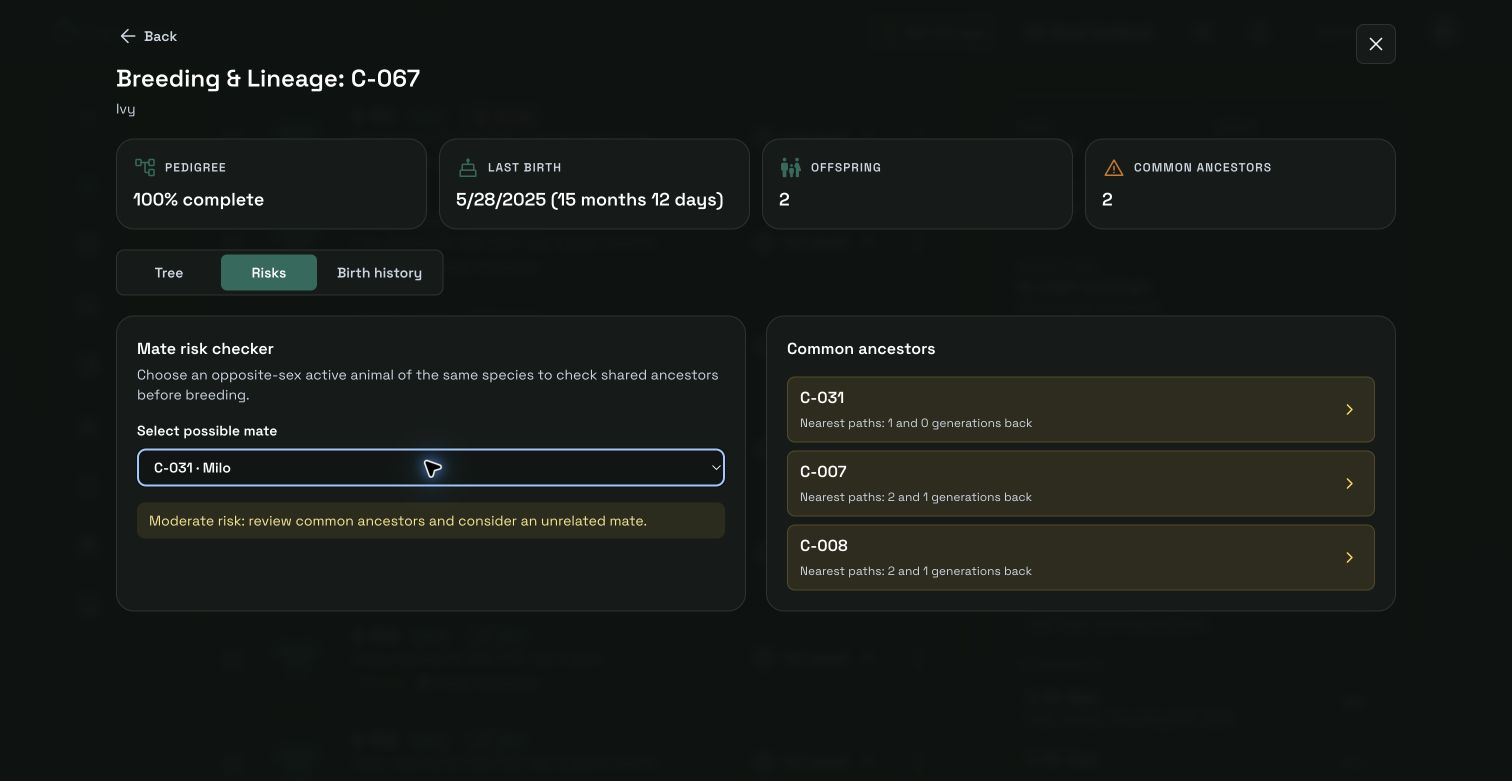
In the example above, the selected mate is a close relative of the cow, so the checker prompts the user to review common ancestors and consider an unrelated alternative. It is a decision aid: the final choice should also account for genetic merit, known conditions, breed guidance, and your herd’s long-term objectives.
A simple breeding workflow for cattle
- Set the breeding goal first: for example, calving ease, maternal traits, milk solids, growth, or replacement quality.
- Confirm the dam’s identity, health status, reproductive history, and pedigree completeness.
- Shortlist sires that meet your performance and breed criteria.
- Run a lineage and mate-risk check for each realistic pairing—not just the final choice.
- Review shared ancestors, known recessive conditions, and the estimated inbreeding exposure with a qualified advisor where needed.
- Record the selected sire and service date immediately, then record pregnancy outcome, calving and calf parentage.
Avoid the common record-keeping traps
- Relying on memory for parentage, especially across multiple calving groups.
- Using nicknames instead of unique animal IDs for sires and dams.
- Recording a service but not linking the animal to the actual sire used.
- Treating missing pedigree information as evidence of no relationship.
- Checking risk after a mating rather than while alternatives are still available.
- Ignoring repeats of the same influential ancestor across several generations.
Make better genetics a repeatable habit
A well-kept pedigree is not paperwork for its own sake. It gives you a clearer view of the decisions shaping the next calf crop. Once animal identities, parents, services, births and outcomes are recorded consistently, you can review a prospective mating in minutes instead of reconstructing it from notebooks, messages, and memory.
Ready to turn insight into action? Farmleo keeps your herd data organized so you know what to do next in every season.